Tuesday, September 30, 2008

Learn About Salsa Dance


Salsa resulted from centuries of dance evolution, brought about by economic, social and political changes. It originated in the ports of Cuba during the colonization of the Spaniards, who imported slaves from Africa; bringing with them their culture, the Africans introduced their rhythmic dance styles to the Caribbean, giving birth to Afro-Latin dance hybrids like Son, Cha Cha, Danza, Mambo and Rumba.


Salsa has risen to the status of a world dance. People from all cultures are relating to it, there are indeed more Salsa clubs in major cities like Los Angeles, New York or London than in its historical homes like Cuba and Puerto Rico.

Salsa music has an addictive quality inherent in its rhythm which fuels the desire .....

Read on more at Arts Origin.com


Music in Sweden


Singing is popular in Sweden, and of its 9,000,000 inhabitants, 600,000 belong to various choirs. Two of the world's leading songwriters, Jörgen Elofsson and Max Martin live in Sweden.

ABBA , the mega music group became the essence of Swedish music during the 70's and early 80's. Later emerged Roxette, singing happy music into the 80's, and this band was as compare to ABBA, successful in the U.S. Europe, Ace of Base and The Cardigans are some of Swedish pop groups to gain fame the world over.

It is the status and popularity of music lovers in Sweden that Britney Spears had at least one of her early albums produced here, and so have Bon Jovi and the Backstreet Boys.

Many of these bands such as Read More at ....ArtsOrigin.com

Know About Candid Photography


Candid photography is best described as un-posed and unplanned, immediate and modest. Unlike classic photography, which includes aspects such as carefully staged portrait photography, landscape photography or object photography, candid photography catches moments of life natural and un posed. The events known are often private, they involve people in close relation to something they do, or they involve people's relation to each other. For instance, pictures taken at children's birthday parties; the pictures a wedding photographer takes at the reception, of people dancing, eating, and socializing.

To take candid pictures you have to have a good eye for detail and ...... Read More at ArtsOrigin.com

Monday, September 29, 2008

Knowing Swedish Art and Culture


Swedish people are very lifestyle conscious; they don’t like to be too jazzy, they love to share and they live in self-control. They are very conscious of how they live affects people around them, as well as the surroundings. A concept Logom, which means “just enough”.

Homes
Nearly all Swedes in live towns and cities and have small families. Their homes are spacious and bright and are insulated well to keep them warm in the winter.

Education
Education plays significant role in Sweden and school, known as grundskolan, is compulsory. Swedish toddlers attend preschool which is provided by the government, while it is not compulsory. Most kids start grade school at the age of 6 or 7. The government funds all schooling and provides free books.

Swedish kids learn many traditional hobbies in school like knitting, embroidery, woodcarving, lace making, rug making, candle making and blacksmithing. One in three children in Sweden go to post secondary education which is free.

Arts and Culture

Read More at Artorigin.com

The Impressive Italian Culture


With 40 million visitors every year, Italy is the fourth most visited country on earth. Museums, churches, courtyards and statues proudly display the treasures of some of the greatest artists: Leonardo De Vinci, Michelangelo and Raphael, to name a few. The beauty of Venice with its canals, Rome with its Coliseum, and Florence with its heritage of art, are enhanced by the hospitality extended by the people. They do not hesitate to welcome strangers into their towns and homes, and are always ready to share a meal or a story, a good joke or a song.

Italy has a population of over 58 million people in an area slightly larger than the state of Arizona. The traditional Mediterranean culture has had its influence on the central and southern parts of the country. Here, most Italians are shorter with olive skin and dark hair. In north, people are ...read more at Artsoirigin.com

Sunday, September 28, 2008

The Art of Élan

When there is a bringing together of the visual arts and music, both art forms may be elevated and enhanced because of how one complements the other. The Art of Élan is just such an endeavor; an attempt to provide a more engaging experience for concert goers, so that their senses are constantly being stimulated by the various artistic elements being presented to them. The music is sought to be presented in an "artistically stimulating and invigorating environment."

Read more

The Porziuncola Recreated in San Francisco

It is appropriate that the biggest city named after the Saint Francis that is San Francisco, should build a replica of the very chapel in Italy where the saint is said to have heard the call of Jesus and which became his home and that of his disciples as well. Porziuncola is a small church situated about 4 kilometers from Assisi, Umbria (central Italy).

The chapel is known for artistic embellishment accorded by artists from different periods. Read more

La Princesse: Arachnophobics Beware!

While I don’t dislike spiders, I am also not the sort who would willingly watch a film like Arachnophopia, so I am fairly sure that I would not like to meet a 50 foot spider either. Arachnophobics, beware, there is a giant mechanical spider around, designed and operated by French performance art company La Machine. Its called La Princesse and was showcased in Liverpool, England, as part of the 2008 European Capital of Culture celebrations, travelling around the city between 3-7 September.

This Shelob-ish (evil thing in spider form from Lord of the Rings) creature moves, it sprays water on passersby, it climbs buildings etc.

Read more

Saturday, September 27, 2008

Paul Newman: The Passing of an Era


I saw the movie The Sting at age 13 and two things happened, it awakened a new appreciation of Hollywood films in me and I developed a massive crush on Paul Newman; I was hard pressed to choose between Paul Newman and Robert Redford actually, but found Paul Newman more irresistible, more suavely handsome, more cool and those blue eyes cast a sort of spell. I so agree with L A Times when it says that he wielded his beauty like a craftsman.

Read more

The Italian Art - Reviving the Style and Culture

Italian culture and Roman empire has impressed the world since times immemorial. Be it Italian pizza or the roman pillars, Italian food, culture, style, architecture, has withstood the test of times and amazed the new generation with each passing year. Every year thousands of students study the Roman culture, art, paintings, sculpture and each student interpretes the style and work of master in his own way.
REad on more at ArtsOrigin.com

Friday, September 26, 2008

Political Correctness: The enemy of Art?

Political correctness is viewed as the new censorship, the new curtailment of the freedom of expression and speech, even the freedom of thought. Though political correctness supposedly seeks to minimize offense to gender, racial, cultural, disabled, aged or other identity groups, the term is mostly viewed in the pejorative sense. Increasingly new ideas, different ideas, change, even originality is sought to be stifled under the pretext of political correctness.

Read more

The Art of Happiness

Is happiness an art; do you have to learn how to be happy? I think that the answer is YES! Many of us forget to be happy sometimes; we forget to appreciate and take happiness from the little joys of life. We sometimes forget what are the important things in life; the good things that we should be concentrating on and little niggling worries that we should be paying less attention to.
The book Art of Happiness by the Dalai Lama and Howard Cutler is a work that reminds us of the fact that happiness is perhaps the purpose of our life. The book is based on

read more

Learn the Art of Photography

Photography is a wonderful way of capturing not only reality, but your perception of reality. It is one of the easiest arts to enjoy unlike painting or sculpting which requires some amount of practice. With digital cameras on the mobile phones, these days anyone can enjoy photography in the way like never before. Everything in photography comes down to one word vision. Call it vision, imagination, or seeing; it all comes down to the same thing: the ability to envision a final result in your mind's eye, and then to make it so with your tools at hand. Today, photography has become a powerful means of communication and a mode of visual expression that touches human life in many ways. For example, photography has become popular as a means of crystallizing memories.

Israel’s 60th Anniversary Celebrations

Fireworks, concerts and an aerial display were among the events that marked Israel's 60th Anniversary Celebrations. Israel declared itself an independent state on 14 May 1948, three years after the end of World War II and the death of six million Jews in the Holocaust. The celebrations of the 60th anniversary are still ongoing, Paul McCartney having performed for an estimated 40,000 strong crowd in Tel Aviv on 25 September 2008.

Many celebrations marked Israel's 60th Independence Day celebrations in May; among them

read more

Thursday, September 25, 2008

The Museum of Arts and Design Opening this Weekend

The Museum of Arts and Design or the MAD museum in New York opens this weekend which Businessweek has termed as a marvel of appropriate and beautiful design. The Museum of Arts and Design is a center for the collection, preservation, study, and display of contemporary hand-made objects in a variety of contemporary media, including: clay, glass, metal, fiber, jewelry ceramic and wood. While the museum was founded more than 60 years ago, it has recently completed a controversial move to redesign of 2 Columbus Circle.

Read more

Wednesday, September 24, 2008

'Film Liberator' Initiative of the German Film Industry

The German Film industry dates back to the start of the film as a medium at the end of the 19th century. This venerable industry however has had its lean patches and is feeling that films are losing out as a medium, by being shown on TV and have launched an initiative in Berlin called the 'Film Liberator' to 'liberate' cinema from television and deliver it back to the cinema halls where it rightfully belongs.


To illustrate this point, they used a unique and original method of publicity

read more

Angel of the North: Gateshead's Winged Wonder

The Angel of the North is a sculpture that stands 6 feet (20 metres) tall, with wings measuring 178 feet (54 metres) across (nearly the size of a jumbo jet and wider than the statue of liberty) located at Gateshead, England. The Angel of the North in made from Corten, a weather resistant steel. The sculpture weighs about 200 metric tons (100 for the body and 50 tons for each of the wings). This has become one of the icons of England and is one of the most viewed pieces of art in the world; attracting some 30 million visitors a year! It took about 4 years and a million pounds sterling to make the sculpture; it was made in a factory in three parts and then transported to the site and assembled.


Anthony Gormley, the sculptor says, People are always asking why an angel? The only response I can give is that no-one has ever seen one and we need to keep imagining them. The angel has three functions -

read more

Official Music Album from Barrack Obama

One man who may create history is Barack Obama. He has already made news by defeating Hillary Clinton and now he is running for the presidential elections as candidate from the Democrats. He is now ready to top the charts with his new official music album. It is an official campaign album titled Yes We Can: Voice of Grassroot Movement produced by Hidden Beach Recordings. It is on sale at http://www.barrackobama.com/ where digital form is available at $24.99 while the physical copy is available at $30.00.

All the proceeds from this 18 track CD shall go towards politician's campaign. ....

Read on more at http://www.artsorigin.com/news.php?id=98.

The Art Deco Design Movement

Cruising down Marine Drive in Mumbai, you would see a lot of Art Deco styled buildings much like the picture of this hotel Miami; all of them overlooking the sea, some well preserved, some rather seedy and ramshackle looking. Only Miami has more art deco buildings along the seafront than Mumbai. Art deco though was such a popular design mode of its time and such a distinctive and recognizable style that remnants of this style are visible at least in their residuary form all over the world:


furniture,

read more

Tuesday, September 23, 2008

India's Emerging Art Market

In a recent Reuters article titled Indian art offers high appreciation at volatile time Indian Art has been identified as high growth sector from the investment point of view. Indian Art and artists are still perceived to be undervalued and experts opine that growth potential here is huge with appreciation levels between 18 and 25% per annum seen as a reasonable prediction. The art market in India being dominated by investors rather than collectors, this market has gone up 200 times in the past five years and what is being predicted is that if you pay a certain price right now, it will seem like peanuts 50 years down the line. Some art pundits are of the view that some of the Indian artists and their work is almost like a financial commodity rather like a stock. Perhaps one of the last of the tangible assets in a demat world! Among Indian artists currently perceived to be highly desirable in the West, the following names are noteworthy:

Read more

Friday, May 2, 2008

To make the searching process more convenient

· Continue simplifying the search process.

· Make a local buying decision, you usually don't need 10,000 results, but just a few truly relevant and useful results based on exactly what you need.

· Social media marketing.

· I'd like to see Search truly integrated in sites where people spend most of their web time, like social networking sites, blogs and large hubs.

· Figure out how to make more money on my pages, from contextual text ads or other sources without getting ripped off by my agency.

· Social media needs to be organized as something done regularly for blog stories and new site articles.

· Deploy comprehensive strategies across all forms of content (e.g. video, news, mobile, etc.), include image optimization and video optimization, as we are expecting to see the major search engines display more blended results within their main results.

· Profit from all auction-based media in conjunction, including contextual and behavioral keyword targeted media as well as display.

· Solutions to manage these digital assets and our focus for 2008 will involve further development of performance-based asset management tools for an ever-expanding portfolio of online media, including PPC, paid inclusion, image and video ads, among other assets.

· Local search is indeed different from what they expect in a broader search.

· Marketers will tailor their pitches using personal details on users’ profile pages.

· Better way to share the valuable information found on the web than a social bookmarking system.

· Social ads reach consumers based on information within their social networking profiles.

· Social ads which tracks information that users list as well as web sites they’ve visited on their profile.

· Build your community of referrals associates, demographically and by industry.

· Targeted marketing prospects can effectively find you based on your area of expertise and geography.

· Profilactic is a social aggregator that pulls in just about everything you and your friends create online.

· The next generation of search technologies will provide a rich experience for users. Users spend four time as much time with images and video search then they do with text, leverage the stickiest form of connected marketing and advertising actively back to the office from experts in the space.

· Negative posting about you or your company on line.

· News story through a link emailed from a friend in a blog post from a syndicated news feed

· See articles and blog posted by their friends.

SLIDE

Widgets, applications Slide raised $50 million

Valley Girl has learned that Slide has raised $50 million in a round of funding that values the company at more than $500 million. In this fourth round, the investors are not your typical Silicon Valley funding crew, either. This time, Wall Street heavyweights Fidelity Investments and T. Rowe Price ( TROW ) are getting behind so-called widgets, applications like those made by Slide that are all the rage on social networks and other sites these days. If you know Levchin at all, you know he's building Slide with an eye toward an initial share sale, not a quick flip. [1] Slide, the maker of applications for social networks, has raised another round of funding ''' $50 million from the private equity funds at Fidelity and T-Rowe Price.[2]

Mr. Levchin said that Facebook apps may feel frivolous now, but that waves of games, security tools and productivity programs are sure to hit social networks soon. He said he'''ll use Slide'''s new war chest plus leftover funds from three previous funding rounds to expand the staff, keep up with user growth and stay ahead of the competition from rivals like RockYou. '''Being No. 1 does drive advertising and press attention, although we feel we are the smartest and most mathematically inclined anyway,''' he said.[2] When Max Levchin started Slide, the popular tool that lets users create slide shows and other bling for social network pages, it wasn't because he felt passionately that photos needed to be surrounded by animated hearts and glitter. It was because Levchin, who co-founded and later sold PayPal, wanted to prove he could do it again--this time, generating more than the $1.5 billion PayPal fetched from eBay ( EBAY ) in 2002. As of Jan. 14, Levchin was about one-third of his way to his goal--at least on paper.[1] Widgets are grabbing real estate off of everyone else's pages. That's an inherently riskier proposition with far fewer ways to make money. Levchin understands that risk, having built PayPal on top of eBay. But this time, he has several eBays (BusinessWeek.com, 8/23/07)--in the form of MySpace ( NWS ), Facebook, Bebo, and even more niche personal blogs and sites. For the strategy to work, Slide needs to build a jaw-droppingly huge audience--so huge that advertisers will see Slide as a way of advertising across the hottest Web sites in one move, versus advertising on each of those places.[1]

The barriers to entry for building a widget are so low it is a Darwinian fight, and Levchin thrives in that type of situation. Levchin is one of the only people I know in Silicon Valley who actually grew more intense, more hungry after the huge Web 1.0 windfall bestowed on him and PayPal co-founder Peter Theil. That's a big reason Slide is backed by some of the best investors in the Valley already, including Thiel and Vinod Khosla.[1] The figures were outlined in a presentation for Slide investors that was obtained by Valley Girl. As much as Levchin works tirelessly to achieve his goal--believe me, he tweaks and alters his business focus constantly--Slide faces quite a different challenge from that of many Web 2.0 sites such as Digg and TechCrunch, which focus on catalyzing loyal niches. In its own way, Slide is trying to build the next Yahoo! ( YHOO ). This is not a safe bet. It's a big, gutsy, swing-for-the-fences play, and those typically take a lot of money. Counting this round, Slide has raised at least $75 million. At this second, the answer has to be no, by any normal valuation math.[1]

Now investors are trying to peg the next Adobe or Electronic Arts. '''It's impossible for social networks focused on scaling the network itself to build all the niche applications that bring people and keep people on these sites,''' he said. Just as consumers bought Windows to play games, organize their taxes or create documents, application makers like Slide '''add the bulk of perceived value to the consumers of these Web platforms,''' Mr. Levchin said.[2] In that scenario, Slide almost becomes like a huge ad network, only one that's delivering advertising in a far more compelling way. It's not in a banner ad that people routinely tune out. It's ideally worked into a very personalized slide show of your memories. According to comScore ( SCOR ) data for October, Slide ranked ninth in terms of its reach on the Web, right after Amazon.com ( AMZN ). Its applications had 150 million unique users, an increase of 142% over the previous year.[1] How could a widget company be worth half a billion dollars? What is the revenue model? How could it ever make a profit on slide shows running on other people's sites? The naysayers have a point, but I've long thought Slide was a far more valuable property than the Silicon Valley masses gave it credit for. Widgets raise doubts in large measure because they're not bound to any one site. While sites like YouTube ( GOOG ) and Facebook are struggling to wring revenue from the millions of people who come to their sites, they at least can run standard banner and display advertising to buy them some time; they control their own sites.[1]

Call it the Facebook Funding Effect. I am still collecting details, but Slidethe San Francisco start-up whose widgets are among the most popular on Facebook and MySpaceis completing a round of funding that could value it at many times a multiple of its most recent $60 million to $80 million valuation. That would be a large leap from a round that Slide announced in November of 2006 with investors that included Khosla Ventures, BlueRun Ventures, Founders Fund and the Mayfield Fund.[3] SAN FRANCISCO (Reuters) - Social network software maker Slide Inc said on Friday it had closed a $50 million institutional financing round, marking the rising valuations of start-ups riding fast-growing Facebook's wave of popularity.[4] Last year, Microsoft invested $240 million for a 1.6 percent share in Facebook, betting that the rapidly growing social network could mint the next Web platform.[2]

Investors are being sold on the idea of social networks as the new operating system and apps-makers like Slide as the next Intuit.[2] Slide and its founder Max Levchin, as well as its investors, have grander dreams than riding on the coattails of bigger players. They consider the company to be a new kind of distributed content and application company that is not dependent on large platforms like Facebook and MySpace.[3] Levchin said the new cash will be used to boost the size of the San Francisco-based company to about 100 employees and expand the applications it offers on the upgraded MySpace platform. Acquisitions of other so-called social software developers will be a low priority, he said.[4]

Slide, based in San Francisco, makes what it calls tools for personal expression using rich media ''' or in other words, nifty Facebook and MySpace time-wasters that let you display photos, write cute messages on your friend'''s pages, or send the virtual gestures called '''pokes.'''[2] A lot of Slide's current growth has been through taking advantage of the huge spike in users first at MySpace and now at Facebook.[3]

Slide makes a wide range of software, called widgets, that have been attracting many millions of users each. They include everything from slide shows to a program called SuperPoke that allows a user to, well, poke another in a super way.[3]

Some of the advertisers and Web analytics firms used on this site may place "tracking cookies" on your computer. Tracking cookies are small text files that can tell such companies what you are doing online, even though they usually don't record your name or other personably identifiable information. These cookies are used by these companies to try and match ads to a user's interests. They are used all over the Web, but in most cases, their presence is only disclosed deep inside privacy policies. We want you to know how to get rid of these tracking cookies if you like.[3] The reason for getting more funding, said sources, is to be able to acquire other companies and expand, using cash and the stakes in the higher-valued company, much in the same way that Facebook has done.[3] The company calls itself the "largest personal media network in the world, reaching more than 134 million unique global viewers each month and 30% of the U.S. Internet audience." The company recently said reports had put that number at 144 million, excluding its 50 million users on Facebook. Its competitors include other widget-makers like RockYou.[3]

After cashing in big with PayPal, Max Levchin could be at it again with his social network tool. [1] Slide started in 2005, originally self-funded by Levchin and backed by PayPal co-founder Peter Thiel. These earlier rounds of funding totaled in the "low tens of millions of dollars," one of the sources said.[4] Sources said the investment then was $20 million. Slide is reportedly using Allen Co., the media-connected New York-based investment firm, to help them in raising the latest round.[3]

SOURCES

1. Slide: The $500 Million Widget
2. Slide Slides Into Some Cash - Bits - Technology - New York Times Blog
3. Slide Gets Big Funding? | Kara Swisher | BoomTown | AllThingsD
4. Facebook software maker Slide gets $50 mln funding: Scientific American

Masks Exhibition Summary

Our Masks Exhibition utilizes art and celebrity power/talent to create a spectacular event with a lasting impact. Our fundraising concept is simple but powerful. We produce an exhibition of clay masks designed by a variety of high profile celebrities. The masks are shown along with paintings and prints from some of the most prominent artists in the world. All the artwork is auctioned off and the proceeds from its sale are given to charitable causes. The charities we support benefit from the sale of the masks and other artwork and their corporate sponsors enjoy the publicity and brand building generated by the event.

The idea was born in the winter of 1995. Our founder, Henri Boll, sponsored a creative workshop where mentally challenged children were given clay and told to shape a mask. One of the children created an abstract mask with minimalist features. The design seemed a perfect match with the vision of the workshop; that “behind our masks we are all the same.” It was duplicated and sent to 300 famous personalities in the fields of entertainment, music, arts, sports and fashion.

The results have been spectacular. In fact, we have managed to build up the largest selection of celebrity art in the entire world. Our program has a prosperous 9 years of success with more than 200 clients including Lexus, Neiman Marcus, eBay, and Bloomingdale’s. We have also put together an exhibition for Prince Charles’ charity, The Prince’s Trust, held at Buckingham Palace in London.

By now, over 1,000 celebrities have designed masks for us. Our exhibitions also include paintings and prints from well known artists such as Ya’acov Agam, Richard Mock, and Christo and Jean-Claude. We have amassed a database of 40,000 copyrighted images, both originals and copies, which can also be sold at our events. This stockpile allows us to offer masks and artwork at variety of different prices in order to appeal to a wide audience.

We have raised millions of dollars for charities such as the Make-A-Wish Foundation, the American Cancer Society, and the Ronald McDonald House. Our exhibitions have appeared in New York, Rome, Jerusalem, Chicago, London, and Paris. Charities have been able to fundraise in an original and exciting fashion, corporate sponsors have benefited from the publicity generated from the event and the public has been given a unique window into the minds of their favorite celebrities.

Every charity is looking for a compelling and interesting way to fundraise and create excitement about the work they are doing. It is our involvement with these great causes that makes our job so rewarding, especially our history of collaboration with children’s charities. We have found that when a deserving charitable organization is involved, it is easy to persuade celebrities to take the time to design a mask or to convince artists to contribute their work. In fact, a number of celebrities have offered to paint masks for us without a specific event or charity in mind, because they know that the funds raised from its sale will go to a worthy cause. As a result of this trend, we have some 60 original masks available to us of top level celebrities such as Diane Sawyer, Sean Penn, and Liza Minelli. Our exhibitions have been used for a number of different fundraising events including silent auctions, galas, masquerade balls, art shows, and even internet sales. It was our ability to simultaneously present our exhibition in a number of different formats that compelled Prince Charles to give us a call.

While we originally conceived of ourselves as charity fundraisers, we began to realize that in many ways we were a marketing company. Corporations were eager to be involved with our events as they became frustrated with the poor return on investment they were receiving from the traditional forms of advertising. Not only do our exhibitions create a memorable experience for those attending, but they have been covered extensively in newspapers, magazines, and on television. Corporations can build their brand by aligning themselves with charities and celebrities that they feel are consistent with their image, but also they can present themselves as a company that is an innovator, a corporation willing to think outside the box. That charities are also able to benefit from the event has led us to refer to our exhibitions as “win-win marketing campaigns.”

When a company decides to sponsor an event, we make sure that they receive the full benefit of their support. Our staff utilizes a fully integrated marketing and public relations campaign to generate publicity in traditional media as well as on the internet. We have the technology available to set up an auction directly on a company’s own website.As a result of our integrated approach, corporations have come to us not just for the purpose of traditional sponsorship, but in order to help them achieve and surpass specific sales and marketing objectives with our value-added services. Corporations have used our unique marketing campaigns for product launches, networking dinners, real estate sales, and brand building projects. The company’s we have worked with are blown away by the buzz our events are able to generate.

Rich Media Widgets

Online communities are the next generation of social networking sites, and entertainment and social networking applications are emerging as the next powerful model. Continued growth of narrowly focused niche sites will be the next generation business social network. Widgets will provide and overwhelming value to the site’s visitors, as widgets are an engaging way to market products and services on social media, mixing targeted ads with their social search tools. It’s about discovering content, sharing it, using it to express yourself and to communicate. They are an outlet for creative minds in the real and virtual world. Development of distribution strategies for widgets should continue as they are another form of self expression for oneself. It is this mantra and methodology that ArtsOrigin.com, a site revolving around the art field designed to distribute art and to promote other artists along with a young budding online community, is aiming to adopt.

The significance of content based rich media widgets for entertainment publishing has become a vital asset. These widgets are digital alter egos connecting three dimensional virtual worlds which incorporate social networking with advertising interwoven into it. You can enhance your virtual presence and your virtual business networking will be made easy with better job prospects. Create a “virtual you” and interact with people you would have otherwise never met. The proliferation of data readily available online actually creates an opportunity for marketers to generate leads.

People are wowed with widgets, and authoring tool widgets are for the next generation of networking sites. People want to be famous, they want to be creative, and they want to be recognized. One example is a drag and drop Flash authoring tool built on Adobe’s Flex. Artsorigin.com is also striding to let users build sophisticated, multi-page widgets with media.

Approximately half (44 percent) of U.S. adults online are “content creators” – posting messages, running blogs, hosting personal sites, etc. More than half of 12-17 year olds use online social networking sites. There are already more than 70 million blogs, and a new one is launched every second. User generated videos account for 47 percent of total online videos streamed in the U.S. (See “Power to the People.” December 2007, for more about user generated content) Additionally, over half of the developers in scientific and technical fields see social networking as a communications and collaboration medium.

Small businesses including ArtsOrigin are increasingly turning to the internet web space to promote themselves. ArtsOrigin places emphasis on the term “social media site” rather than a “social networking site.” Three million photos are uploaded a day by users, and there is a real emphasis on self expression. ArtsOrigin aims to bolster that. Whether you are an editor, photographer, writer, artist, collector, producer, graphic designer, game designer, video maker, movie producer, book publisher, or a person in other industries including magazines, television, film, radio, newspapers, online media, and advertising, or someone who simply appreciates the field, ArtsOrigin can connect the dots for you and bring dormant ideas into the light. The premise behind our launch is to reach out to creative minds, recognizing their abilities, and bringing their best or abstract ideas into the light.

Monday, March 17, 2008

Breughel Landscape - By Scott Reyburn

A European collector paid $3 million for a Pieter Breughel the Younger painting, “Winter Landscape With the Massacre of the Innocents,'' exhibited by London dealer Johnny van Haeften.

“I'd never seen this person before,'' said Van Haeften. ``That's the thing about Maastricht. You're always meeting new people.'' He said he had sold six paintings, including a 17th- century Dutch church interior by Anthonie de Lorme for $3 million.

Brussels-based tribal art dealer Bernard de Grunne said business at the preview was “unusually good.'' De Grunne had sold seven pieces, led by an Ivory Coast Bete-tribe wood sculpture, priced at 120,000 euros.

A $30 million Van Gogh portrait of a child, offered by the London-based dealers and agents Dickinson, and a $15 million Lucian Freud painting, “Ria, Naked Portrait,'' on the stand of Acquavella Galleries Inc., are among the most expensive works at the fair.

Potential Buyers

The galleries said both works had attracted “significant interest'' from potential buyers at the preview.

The Paris dealer Eric Coatelem said that he had sold Eugene Delacroix's circa-1840 oil sketch, "A Seated Oriental,'' to a U.S. private collector for 1.1 million euros.

Graham Southern, director of the London contemporary-art dealer Haunch of Venison -- whose ownership by Christie's International disqualified it from exhibiting at last year's Basel and Frieze contemporary art fairs -- said the gallery had sold 10 works at its inaugural Tefaf fair. Gerhard Richter's 1964 black- and-white painting “Portrat Schmela'' was bought by a European collector for ``a little under'' $2 million.

Among the dealers in traditional antiques -- a collecting area that has suffered a general decline in popularity in recent years -- Paris dealer Alan Rubin of Pelham Galleries said he sold around eight pieces on the opening night. These included a pair of circa-1775 English painted wood pedestals in the manner of Robert Adam for 160,000 euros.

“Antiques aren't recession proof,'' said Rubin. ``In recent years there's been a flight to quality and if you've got sufficiently good things dealers in traditional things can still do business.''

Manfred Pernice - By Adina Popescu

FROM Artforum.com:

diary, 2008, which takes up a good deal of the floor space in German sculptor Manfred Pernice’s fourth solo exhibition at this gallery, consists of two layers of interlocking particleboard panels. Like monuments, the geometric figures rising from the piece’s “platform” are marked with a date. These dates, however, seem to have been selected arbitrarily; they will be familiar only to those able to connect them with events. Unlike On Kawara’s timetables, which are concerned with the divergent relationship between internal and external times, here one does not experience the sense of time’s passing. Instead, diary places markers into a kind of spatial time landscape; depending on the viewer’s position, these moments are either related through sight lines or disappear.


Gottfried Leibniz designed a model of a continuum in which time and event are equally present in a single space, in either “visible” or “latent” form. The real and the possible, and the meaningful and the hidden, are both always present and always powerful. In Pernice’s exhibition, it is the viewer who produces meaning, drawing a line between these “monuments” printed with dates and creating relationships between them. This act resembles ways of remembering both personal and collective: If our “best of all possible worlds” has just one face, a linear logic, then Pernice’s time landscape, with its synchronicity of all possible events, forms a heterotopia, in which the “possibility-of-being” is a part of our reality, and our point of view always conditions what we see.

Translated from German by Jane Brodie.

The Soul's Sanctum - By Gary Singh

From Metroactive.com:

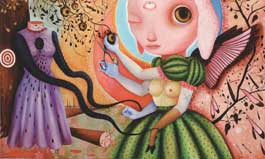
TWO QUOTES immediately come to mind when one steps into Jennybird Alcantara's solo exhibit at Anno Domini of surrealistic oil paintings, Flies in the Buttermilk. The first is that classic passage when Timothy Leary once described Salvador Dali as "the only person who can paint LSD without having taken LSD." And then, of course, one of Dali's favorite quotes is "I don't do drugs, because I am drugs." But that's only the surface analysis of Alcantara's paintings.


The opening reception drew more than 100 people to the downtown San Jose gallery, including legendary illustrator Barron Storey. One particular person walked up to me and said, "I don't know who the artist is, but she's obviously got access to much better drugs than I do." So I pointed him in Alcantara's direction and told him to go tell her that and see what she said.

Alcantara's paintings may look like euphoric drug-induced dreamscapes to some, but the artist says she doesn't do drugs at all. Like many shows at Anno Domini, Flies simply explores the darker side of human nature and exposes the brutality underlying even the simplest of things.

It's a yin-yang take on fairy lands, with broken hearts and severed arms accompanying childlike imagery. The paintings fill the gallery with huge eyeballs, broken hearts and amputated limbs. (You just can't go wrong with amputated limbs, by the way.)

Several of the works feature humans morphing into animals. "They can't be just human or animal," Alcantara said. "It has to be a cross between both." One hit at the reception was a small oil-on-wood piece featuring a girl's head morphing into a wolf's head. Alcantara calls it her "Little Red Riding Hood" piece.

Other pieces feature the female form with elephantine heads and trunks. They recall the famous W.C. Fields quote "Women are like elephants. They're nice to look at, but I wouldn't want to own one."

Huge extraterrestrial-like eyeballs also dominate most of the works. "The eyes started getting bigger when I started painting dolls," Alcantara said. And the exhibit also contains a few painted dolls that relate to the oil paintings.

In the gallery's retail space, one finds the Bleeding Heart Gang Dolls, a set of dolls fashioned from acrylic paint, cotton, felt and wool. Like the paintings, they explore the mosaic of characters within every human being. Many of the paintings likewise feature bleeding hearts and multiple personalities.

But getting back to amputated limbs, there appears to be a reason why many of these oil paintings feature disconnected arms and such. I hear that the artist has a hard time painting exactly what she sees in her head, so there's a disconnect of some sort. She also said she likes to let the paintings speak for themselves, rather than engage in some elaborate oration explaining what they mean.

The title of the exhibit comes from the old children's tune of the same name and if you go online and actually look up the song "Flies in the Buttermilk," there are instructions for teachers: "If students don't know what buttermilk is, then call it yellow milk. Explain that the milk is spoiled and that's why the flies are in it." That, in a nutshell, is Alcantara's exhibit. We're all spoiled milk. Flies are drowning inside every single one of us.

But with all this vivid imagery of the soul's divided inner sanctum, more than anything the paintings simply explore the opposing inner selves within the human creature. As Norman Mailer once said, "We're all divided souls; we've got two natures in us. You measure schizophrenia not by the fact that you're divided but how well the divisions speak to one another."

I just don't know if I can ever drink buttermilk again.

De Kooning, Roman Body Parts Lead Sales Maastricht

By Scott Reyburn

March 7 (Bloomberg) -- A $5 million Willem de Kooning painting and a Roman bronze head sold at Tefaf, the world's largest art and antiques fair, in the Dutch city of Maastricht, which opened today.

De Kooning's 1986 abstract ``Untitled'' topped a 1958 painting by fellow American Abstract Expressionist, Joan Mitchell, which went for $4 million, said contemporary-art dealers Hauser & Wirth. The Roman head also sold for 425,000 euros ($653,500) at the invitation-only preview yesterday.

A diamond necklace worth 1.2 million euros was stolen yesterday from the stand of a U.K. dealer who does not want to be identified, said Tefaf. It said three people had been arrested and the necklace, made in 1948 by the American goldsmith William Ruser, had not been recovered.

The organizers of the 21st Tefaf, officially called the European Fine Art Fair, said that in 2007 more than $500 million of art sold at the fair or soon afterwards. The 220 dealers from 15 countries exhibiting this year face growing concern about a U.S. recession and the effect of a drop in the dollar to record lows versus the euro.

Tefaf's press office said 9,500 invited guests attended the private view, 22 percent more than last year.

"It seems to be stronger this year,'' said London-based antiquities dealer Rupert Wace. "We've sold around 15 pieces. We're doing good business with ancient body parts,'' he said after selling the Roman bronze head as well as a bronze foot, also Roman, for 30,000 euros. The foot went to a Spanish collector in his twenties, who usually buys contemporary art.


Friday, February 15, 2008

Ice Hotel Quebec Canada

Discover the amazing 3000 m2 complex made entirely of snow and ice. Located inside you will find the popular Ice Bar, the magnificent ice chapel, 36 rooms and theme suites (one special suite does have a fire place and a private spa), a Grand Hall with an ice candelabra illuminated fibre optically, a huge N'Ice Club with a capacity of 400 people, three outdoor hot tubs and a sauna.

Enjoy a full array of winter activities: cross country skiing, skating, snowshoeing, sliding, dog sledding, snowmobiling, and ice fishing (equipment rentals offered on site). Hold your own special event (happy hour, receptions, corporate events, and weddings) and even spend a magical night (many packages available, capacity of 86 people).

Located at the Station touristique Duchesnay (25 minutes west of Québec City).


Ice Hotel Sweden

Sweden's Ice Hotel is built from scratch every year. A new design, new suites, a brand new reception - in fact everything in it is crisp and new. The Ice Hotel is situated on the shores of the Torne River, in the old village of Jukkasjärvi in Swedish Lapland.

10 000 tons of crystal clear ice from the ‘ice manufacturing plant’, the Torne River, and 30 000 tons of pure snow generously supplied by Mother Nature are needed to build the Ice Hotel every year. The hotel sleeps over 100 guests, and every bedroom is unique.

Covering more than 30,000 square feet, the Ice Hotel includes an Ice Chapel, the hotel itself, an ice art exhibition hall, a cinema and last but not least, the world famous ‘Absolute Ice Bar.'


Wednesday, February 13, 2008

Virtual Museum of Political Art

A work of art is always intertwined with its society’s social and political environment. It is a mirror reflecting our time with the medium of a teacher showing us the essence of our lives. The manipulation of an object in contemporary artworks typically function either as critical commentaries or as expressions of personal psychology and experience. Art is about the power to take ordinary things and arranging them to produce a transcendence of their standard appearances. The originality is what one chooses and how it is presented.

Political art is a significant form of political communication - artistically produced messages challenging status quo and thinking on politics, consumption, economics, and culture.

HILLBILLY

Essay by Mark Vallen at art-for-a-change.com

History provides abundant examples of how social relations impact art. Traditionally the church, state, and wealthy patrons have funded the arts in order to increase their political power and prestige. Clearly that paradigm is overloaded with political relationships. But today it is largely market forces that determine the success or failure of art, and who among us will declare capitalism is not free of politics. Since labor and commerce are realms understood to be political spheres, then art, which is inextricably bound to those fields, is automatically part of a political process.

Content or message notwithstanding, artists manipulate and transform raw materials into art. The fact that those supplies are created from the toil of others makes for a political construct. Who makes your art materials, how much are they paid, and under what conditions do they work? Seen in such a context, can any work of art truly be above politics?

Artists do not create in a vacuum, they are indisputably coupled to the society and times in which they work. It may well be that an artist can realize aesthetic triumphs while ignoring society, but willful unconcern regarding social matters is also a political position.

But what about the transcendent qualities of art, doesn't that universality place the arts soaring above the corrupt world of politics and the vulgar materialism of society? Doesn't the spirituality of art keep it free from the constraints of avarice? Doesn't the mystical aspect of art place it above earthly and mundane concerns? Yes and no. Art will always strive to be free of society's manacles, and it will forever serve as a conduit to humanity's higher self, but the questions posed here imply an intrinsic relationship between art and material reality. It is an ironclad fact that an artist must eat and pay rent, and so it is also an irreducible fact that we are bound to political arrangements.

The Line Up series by Nora Ligorano and Marshall Reese depicts people from the Bush administration in fake mugshots.

BUSH DOESN'T SHOW

From Art News Blog by Dion Archibald

Art prints at the New York Public Library have created a mild stir. The NY Times has reported that a number of library patrons have protested because of a series of 8 digital prints in the "Multiple Interpretations" exhibition called "Line Up."

The Line Up series by Nora Ligorano and Marshall Reese depicts people from the Bush administration in fake mugshots. The slates that they hold have the dates of lies or exaggerations about Iraq spoken by the holder. For example, President George W Bush in his State of the Union address on January 28 (my birthday!), 2003, reported, "Saddam Hussein recently sought significant quantities of uranium from Africa…. He clearly has much to hide."

"It is at first mildly shocking to come upon such bluntly partisan artwork on a New York Public Library wall. Biting political satire is deeply a part of printmaking history — see Goya, James Gillray and Daumier — but handmade prints are no longer a significant form of political communication, and we don’t expect anything so brazenly tendentious in the public library context." New York Times

My opinion on the situation is that politics and art don't happily mix, but I do love a good political cartoonist. I think artists should have the right to say things that are political though, without it costing them their freedom. Most political art has a very short shelf life, just like the politicians they depict. The best way to make political art live a little longer is to hire a bunch of protestors to march at the exhibition or to have the artist put in prison.

Friday, February 8, 2008

The Art Market - An Article by Nicholas Forrest

Contrary to the media’s portrayal of the art market, you don’t have to have a seven figure budget to invest in art so don’t bother trying to find reports on the sale of $5000 artworks in the mass media because you will be wasting your time.

There is no doubt that an analysis of the high-end of the art market would produce far from positive results because the increase in the sale price of high-end works is being fueled by new, mega wealthy individuals from countries such as Russia and China who are spending as much money as it takes to purchase entry into the elite cultural circles of wealthy art collectors. It is this ferocious demand for expensive, iconic artworks that has resulted in a scenario where the market value of these works is rapidly increasing at a rate considerably faster than the rest of the art market. In order for balance to be restored one of two events would need to take place, the first option being the rest of the art market catching up to the higher-end which is extremely unlikely. The second, more likely option is a correction of the high-end prices bringing market growth in this sector into alignment with the rest of the art market. It is hard to say exactly when this correction will take place but at some point even the mega wealthy will have to consider cost versus value even if they are more interested in social and cultural status than financial return.

Many of you may be aware of the downturn of the art market in the early nineties which followed the art market boom of the late eighties, so what makes the current market so much less vulnerable?? Well, here’s why:

Globalization - The recent globalization of the art market has meant that the art market is bigger than ever thus increasing its stability and long term viability.

Greater Transparency - The popularity and acceptance of art investment has meant that more and more data is available which gives people peace of mind, confidence and allows them to assess the art market based on hard evidence.

Contemporary Focus - The current art market is very much focused on contemporary art which means that there is a constant flow of new work to feed the market and fuel people’s interest. In the past the art market has been more focused on works by old masters and other “historical” artists which has caused the market to rely on the re-circulation of a limited supply of works.

Although the art market is stronger than ever it is important not to become complacent and ignore the primary rules of art investment which are:

1. Art is a long term investment which means that you should be looking at holding your investment for a period of 7-10 years but you also should be prepared to sell at any time if the market presents a favorable opportunity.
2. Art is a good form of diversification and should form part of a balanced investment portfolio.
3. Diversification of your art portfolio is important to spread the risk
4. Research artist, artwork and dealer thoroughly and get several opinions

In conclusion, there is considerable evidence to suggest the art market will continue to increase in strength and popularity but as long as the media continues to present an analysis of the art market based on a narrow sector (high-end) of the market there will continue to be conflicting reports about the status and long term viability of art as an investment. I would therefore suggest that you approach art investment as you would any other investment by analyzing the suitability of art as part of your investment strategy and considering art as a form of diversification that can provide balance and stability to your portfolio with the added bonus of being a pleasure to own.

Jody Barton

Jody Barton studied illustration and graphic design at Camberwell College of Arts and then The Royal College of Arts. He quickly went on to establish himself as one of the UK's best known - and least employable - graphic artists. A talent for words as well as visuals gives his pieces an often polemic and confrontational tone. With wide ranging interests including the production of self published and distributed 'crazy pamphlets', electronic media work for major clients such as MTV and a continuing interest in subculture arts from around the world.

His work often features parades of distorted and comedic grotesques - a rich and dark world of both humor and paranoia. Jody Barton is increasingly interested in working in the cross-over area between commercial art and the gallery show. His contributions to live painting projects such as the Matsuri series and Graffiti Meets Windows show this commitment.


The Hunt for the Red Collector - By Marc Spiegler

He bought one of the most expensive paintings ever sold at an auction - a $95 million Picasso. But no one knows who he is.

On the evening of May 3, a rough-hewn man in a dark sport coat walked into the Sotheby’s auction room on York Avenue. He picked up a bidding paddle at the registration desk and was seated by the staff near the back of the room, in the faraway seats treated as Siberia in the art world’s hierarchy. In the gala atmosphere that now pervades the major evening auctions, the man seemed an odd figure. “He looked more like a KGB agent than a collector,” recalls art dealer Laszlo von Vertes, who sat ­directly behind him. “His nose looked broken, like a boxer’s. He had dyed hair and cheap shoes, like a bodyguard. If he walked into my gallery, I wouldn’t have sold him a painting.”

The crowd seemed buoyant that evening, reflecting the hot art market and the major paintings on offer. But things started slowly. Sotheby’s auctioneer Tobias Meyer launched the sale with a Vuillard still life, which failed to break its low estimate. The next, a floral Monet, did better. Then the rough-hewn man started making vigorous use of his paddle. First he won a Monet landscape for $5 million, a cool $2 million above the high estimate. But that was merely prelude.

The star work that evening was Pablo Picasso’s 1941 Dora Maar au Chat, one of the largest portraits he painted of his Parisian lover, Dora Maar. Its high estimate stood at $50 million, but the bidding quickly soared to $60 million, then $65 million—and the man at the back of the room was coming on strong. Typically, bidders are subtle with their signals to the auctioneer: an eyebrow twitch, a nod, a removal of the glasses. But for the Dora Maar, says Von Vertes, the unknown man was “waving his paddle so hard he was fanning my face.” Such intimidation tactics are not unheard of, but deploying them at these prices was extraordinary. “Usually, whenever the bidding goes above $5 million, it becomes more temperate in its rhythm,” says Meyer. “But he always came right back with the next bid.”


Warhol Collection - Article by Olivia Cole of The Sunday Times

The world's largest private art collection in the world, by Andy Warhol’s is owned by Jose Mugrabi from Bogota, Colombia, the largest Warhol collection warehouse in Newark, New Jersey.

Andy Warhol, born Andrew Warhola in 1928, is considered to be one of the principle founders of the Pop Art movement during the 1960s. An author, filmmaker and music producer, he is most known for his silk screens depicting commercial objects and celebrities.

Last month Alberto Mugrabi described Warhol as a blue chip investment equivalent to owning shares in Microsoft. This week a 1963 Warhol silkscreen, Green Car Crash, will be auctioned at Christie’s in New York. The estimate is £17.5m.

Among the Warhol works owned by the Mugrabis are silkscreens of Chairman Mao — in fuchsia pink — Elizabeth Taylor, John Lennon, Jacqueline Kennedy, Mick Jagger, Debbie Harry, Sylvester Stallone and Michael Jackson.

Shot Blue Marilyn

Jackie


Art Artifacts by Elisabetta Povoledo of NY Times

Looted Art effects by Italian dealer Giacomo Medici, will return to Italy. The Italian dealer convicted in 2004 of trafficking in illegal antiquities was arrested in 1995.

Italian culture minister Francesco Rutelli, confirmed this week a rare fifth-century B.C. Greek vessel will go back to Italy in 2010.

Ms. White, the wife of Leon Levy, who died in 2003, was given back the artifacts bought in good faith by Mr. Leon Levy had no knowledge of the artifacts looted or where they may have been clandestinely excavated.

Mr. Levy, a Wall Street financier gave $20 million to finance the MET’s expanded wing of Greek and Roman art, which reopened last spring; the Leon Levy Foundation, for which Ms. White is the lead trustee made a $200 million gift of cash and real estate to New York University that will finance a new Institute for the Study of the Ancient World.

The 10 items include some of the finest showpieces in any private collection of classical antiquities in the world.

Until recently, some were on view at the MET in an extended loan, including a red-figured vessel depicting Herakles slaying Kyknos, signed by the celebrated fifth-century B.C. painter Euphronios, and a pot with scenes of Zeus and Herakles attributed to the fifth-century B.C. painter Eucharides.


Chinese Artist Cai Guo-Qiang

There's some really interesting painters working in China at the moment. Here's a popular art gallery in China that exhibits emerging and established Chinese artists. I love the figurative painters. Especially the quirky ones. He is one of a number of contemporary Chinese artists that are hot at the moment. A set of drawings by Cai Guo-Qiang sold at auction recently for about 19 million. Until now, Chinese artists created works criticizing the Chinese government. Such works easily interested and appealed to Western audiences. But now that the Chinese government is no longer their enemy, Chinese artists cannot continue criticizing the government just to make art.

Eva M. Paar, Austria

She represents humans or abstracted figures by a play of parallel and differently broad lines. Eva M. Paar primary uses earth-colors, in order to give a warm and pleasant character to the oil paintings, which stands in contrast to the often coolly selected motives. Represented humans and scenes do not only dissolve by differently broad lines, but close together lying color gradations support the realistic effect from the distance. They let more exact outlines as well as shade develop.

Laurent La Gamba

Laurent La Gamba (b. 1967) is an artist, photographer, and video artist interested in pro-crypsis (camouflage). La Gamba’s projects span a variety of in situ installations, performances and photographic installations to look at Procrypsis in relationship to the world of urban space and technology. His work aims at creating a kind of urban camouflage (“homochromie”in French) that mimics what is naturally found in nature with Procrypsis, using painting, photography and video as a tool. This background explains the term for his work: Pro-cryptic Photography.

La Gamba's work is based on this utilization of the urban space as a reflection on the self and explores through identification processes the chromatic response of the human body to the urban environment. He is known for his public supermarket camouflage photographs (Pet food, 2002) and for his peculiar use of consumer appliance objects extracted from their original environment and camouflaged into a natural setting (Open fridge, 2002). He carried out several works-in-progress based on audiovisual performances conducted under the action of camera circling (Full open fridges, 2003).

Previously, La Gamba studied literature at the Sorbonne/Paris, specializing in the clinical aspects of French psychoanalyst Jacques Lacan’s work. He began his work with photo-realistic self-portraits (One hundred Self-portraits, 1999). He received a grant from the Pollock-Krasner Foundation, and since 2002 holds an artist-in-residence position at the La Napoule Art Foundation.

Masks - Article by Roberta Smith of the New York Times

The mask is one of the most basic and recognizable of all forms, and for good reason. One way early humans made sense of the universe was to personify its forces, and the most visible form of personification was the face. Masks have long been central to religious rituals, serving as tools of transformation and bridges to the spirit world. They have figured in ceremonies intended to ensure fertility and raise the dead, make crops grow and rain fall, kill enemies, ward off evil and cure sickness. They have been used by soldiers and celebrators of Lent, astronauts and action heroes, hockey players and fencers, firefighters and welders.

The ubiquity of the mask, regardless of time, place or purpose, is the impetus behind “Mask,” a sprawling show at the James Cohan Gallery in Chelsea. Subtitled “an exhibition of historic masks and contemporary works curated in collaboration with Joseph G. Gerena Fine Art,” this gathering of more than 40 masks and hoods, and more than 30 works in sculpture, video and photography, is a mishmash of cultures and functions in which old and older tend to dominate. This can mean an American firefighter’s goofy-looking smoke hood from around 1900; a carved and painted wood exorcism mask from 19th-century Sri Lanka; or a terra-cotta jaguar/man mask from Ecuador (700-300 B.C).

These and about 40 other masks from sub-Saharan Africa, Latin America, premodern Europe, turn-of-the-century America and several parts of Asia do most of the showstopping here. All were provided by Mr. Gerena, a private dealer who seems to have an excellent eye and, along with Mr. Cohan and his staff, has orchestrated an installation full of interesting cross-references and juxtapositions.

The show is also commendable for not being loaded with the gallery’s artists; only 4 of the 32 contemporary works here are from Team Cohan. This includes the opening salvo, a riveting video by Yinka Shonibare that may be one of the best things he has ever done. It shows a highly stylized masked ball in which the guests wear 18th-century garments made from Mr. Shonibare’s distinctive Euro-African fabrics, which is not new for him. But in this case he has used a combination of sound and movement to strip a minuetlike dance down to a tribal, almost animalistic ritual while still leaving its mannered veneer intact.

Beside the door to the video gallery there is an Oddfellows hoodwink from early-20th-century America. A small, neat variation on the masks seen in Mr. Shonibare’s video, it combines a leather eye mask and eyeglasses. It looks like something Amelia Earhart might have worn, except that the eyeglass lenses have little hinged covers that were raised and lowered as the Freemasons’ initiation rites progressed.

In the main gallery there is a lively interchange among historic masks from different cultures, with intermittent input from contemporary works. First, a row of seven masks confounds expectations. An 18th- to 19th-century skull mask from the Tibetan Sherdukpen people of northern India seems made to order for a Mexican Day of the Dead festival, while what looks like an African monkey mask is actually from Nepal.

The show emphasizes these transcultural twists and turns. A 19th-century Italian carnival mask made of painted papier-m‚chÈ has much in common with a demonic mask of a Tibetan king used in ceremonial dances in 18th- or 19th-century Bhutan. (It’s made of the same material.) A pale, moonlike mask with a woebegone expression and a pale, angular, grinning visage next to it — both in carved, painted wood — might almost belong to the same comedic drama. Yet the moon mask is Korean, for satiric dances; the angular one is Swiss, a witch’s mask for winter festivals.

Many of the masks in this part of the exhibition are feats of construction and conjuring. Consider a spirit mask from Papua New Guinea used in male initiation rites; it is made mostly of tapa cloth, reeds, grasses and seed pods, with its conical hat, wide ears and long, wolflike snout toothed with sharp nails. Or an Eskimo shaman’s mask made of wood, wire and feathers. Its stern face, with the black goatee and curled mustache of a dime-novel villain, is encircled by two rings of twig from which tiny hands and feet sprout. It seems to orbit toward us, getting bigger every second.