Monday, March 17, 2008

Breughel Landscape - By Scott Reyburn

A European collector paid $3 million for a Pieter Breughel the Younger painting, “Winter Landscape With the Massacre of the Innocents,'' exhibited by London dealer Johnny van Haeften.

“I'd never seen this person before,'' said Van Haeften. ``That's the thing about Maastricht. You're always meeting new people.'' He said he had sold six paintings, including a 17th- century Dutch church interior by Anthonie de Lorme for $3 million.

Brussels-based tribal art dealer Bernard de Grunne said business at the preview was “unusually good.'' De Grunne had sold seven pieces, led by an Ivory Coast Bete-tribe wood sculpture, priced at 120,000 euros.

A $30 million Van Gogh portrait of a child, offered by the London-based dealers and agents Dickinson, and a $15 million Lucian Freud painting, “Ria, Naked Portrait,'' on the stand of Acquavella Galleries Inc., are among the most expensive works at the fair.

Potential Buyers

The galleries said both works had attracted “significant interest'' from potential buyers at the preview.

The Paris dealer Eric Coatelem said that he had sold Eugene Delacroix's circa-1840 oil sketch, "A Seated Oriental,'' to a U.S. private collector for 1.1 million euros.

Graham Southern, director of the London contemporary-art dealer Haunch of Venison -- whose ownership by Christie's International disqualified it from exhibiting at last year's Basel and Frieze contemporary art fairs -- said the gallery had sold 10 works at its inaugural Tefaf fair. Gerhard Richter's 1964 black- and-white painting “Portrat Schmela'' was bought by a European collector for ``a little under'' $2 million.

Among the dealers in traditional antiques -- a collecting area that has suffered a general decline in popularity in recent years -- Paris dealer Alan Rubin of Pelham Galleries said he sold around eight pieces on the opening night. These included a pair of circa-1775 English painted wood pedestals in the manner of Robert Adam for 160,000 euros.

“Antiques aren't recession proof,'' said Rubin. ``In recent years there's been a flight to quality and if you've got sufficiently good things dealers in traditional things can still do business.''

Manfred Pernice - By Adina Popescu

FROM Artforum.com:

diary, 2008, which takes up a good deal of the floor space in German sculptor Manfred Pernice’s fourth solo exhibition at this gallery, consists of two layers of interlocking particleboard panels. Like monuments, the geometric figures rising from the piece’s “platform” are marked with a date. These dates, however, seem to have been selected arbitrarily; they will be familiar only to those able to connect them with events. Unlike On Kawara’s timetables, which are concerned with the divergent relationship between internal and external times, here one does not experience the sense of time’s passing. Instead, diary places markers into a kind of spatial time landscape; depending on the viewer’s position, these moments are either related through sight lines or disappear.


Gottfried Leibniz designed a model of a continuum in which time and event are equally present in a single space, in either “visible” or “latent” form. The real and the possible, and the meaningful and the hidden, are both always present and always powerful. In Pernice’s exhibition, it is the viewer who produces meaning, drawing a line between these “monuments” printed with dates and creating relationships between them. This act resembles ways of remembering both personal and collective: If our “best of all possible worlds” has just one face, a linear logic, then Pernice’s time landscape, with its synchronicity of all possible events, forms a heterotopia, in which the “possibility-of-being” is a part of our reality, and our point of view always conditions what we see.

Translated from German by Jane Brodie.

The Soul's Sanctum - By Gary Singh

From Metroactive.com:

TWO QUOTES immediately come to mind when one steps into Jennybird Alcantara's solo exhibit at Anno Domini of surrealistic oil paintings, Flies in the Buttermilk. The first is that classic passage when Timothy Leary once described Salvador Dali as "the only person who can paint LSD without having taken LSD." And then, of course, one of Dali's favorite quotes is "I don't do drugs, because I am drugs." But that's only the surface analysis of Alcantara's paintings.
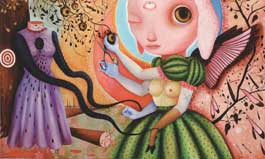

The opening reception drew more than 100 people to the downtown San Jose gallery, including legendary illustrator Barron Storey. One particular person walked up to me and said, "I don't know who the artist is, but she's obviously got access to much better drugs than I do." So I pointed him in Alcantara's direction and told him to go tell her that and see what she said.

Alcantara's paintings may look like euphoric drug-induced dreamscapes to some, but the artist says she doesn't do drugs at all. Like many shows at Anno Domini, Flies simply explores the darker side of human nature and exposes the brutality underlying even the simplest of things.

It's a yin-yang take on fairy lands, with broken hearts and severed arms accompanying childlike imagery. The paintings fill the gallery with huge eyeballs, broken hearts and amputated limbs. (You just can't go wrong with amputated limbs, by the way.)

Several of the works feature humans morphing into animals. "They can't be just human or animal," Alcantara said. "It has to be a cross between both." One hit at the reception was a small oil-on-wood piece featuring a girl's head morphing into a wolf's head. Alcantara calls it her "Little Red Riding Hood" piece.

Other pieces feature the female form with elephantine heads and trunks. They recall the famous W.C. Fields quote "Women are like elephants. They're nice to look at, but I wouldn't want to own one."

Huge extraterrestrial-like eyeballs also dominate most of the works. "The eyes started getting bigger when I started painting dolls," Alcantara said. And the exhibit also contains a few painted dolls that relate to the oil paintings.

In the gallery's retail space, one finds the Bleeding Heart Gang Dolls, a set of dolls fashioned from acrylic paint, cotton, felt and wool. Like the paintings, they explore the mosaic of characters within every human being. Many of the paintings likewise feature bleeding hearts and multiple personalities.

But getting back to amputated limbs, there appears to be a reason why many of these oil paintings feature disconnected arms and such. I hear that the artist has a hard time painting exactly what she sees in her head, so there's a disconnect of some sort. She also said she likes to let the paintings speak for themselves, rather than engage in some elaborate oration explaining what they mean.

The title of the exhibit comes from the old children's tune of the same name and if you go online and actually look up the song "Flies in the Buttermilk," there are instructions for teachers: "If students don't know what buttermilk is, then call it yellow milk. Explain that the milk is spoiled and that's why the flies are in it." That, in a nutshell, is Alcantara's exhibit. We're all spoiled milk. Flies are drowning inside every single one of us.

But with all this vivid imagery of the soul's divided inner sanctum, more than anything the paintings simply explore the opposing inner selves within the human creature. As Norman Mailer once said, "We're all divided souls; we've got two natures in us. You measure schizophrenia not by the fact that you're divided but how well the divisions speak to one another."

I just don't know if I can ever drink buttermilk again.

De Kooning, Roman Body Parts Lead Sales Maastricht

By Scott Reyburn

March 7 (Bloomberg) -- A $5 million Willem de Kooning painting and a Roman bronze head sold at Tefaf, the world's largest art and antiques fair, in the Dutch city of Maastricht, which opened today.

De Kooning's 1986 abstract ``Untitled'' topped a 1958 painting by fellow American Abstract Expressionist, Joan Mitchell, which went for $4 million, said contemporary-art dealers Hauser & Wirth. The Roman head also sold for 425,000 euros ($653,500) at the invitation-only preview yesterday.

A diamond necklace worth 1.2 million euros was stolen yesterday from the stand of a U.K. dealer who does not want to be identified, said Tefaf. It said three people had been arrested and the necklace, made in 1948 by the American goldsmith William Ruser, had not been recovered.

The organizers of the 21st Tefaf, officially called the European Fine Art Fair, said that in 2007 more than $500 million of art sold at the fair or soon afterwards. The 220 dealers from 15 countries exhibiting this year face growing concern about a U.S. recession and the effect of a drop in the dollar to record lows versus the euro.

Tefaf's press office said 9,500 invited guests attended the private view, 22 percent more than last year.

"It seems to be stronger this year,'' said London-based antiquities dealer Rupert Wace. "We've sold around 15 pieces. We're doing good business with ancient body parts,'' he said after selling the Roman bronze head as well as a bronze foot, also Roman, for 30,000 euros. The foot went to a Spanish collector in his twenties, who usually buys contemporary art.